· Marcus Reed
Frame Bag vs Saddle Bag vs Handlebar Bag: An Honest Comparison
Every cyclist eventually runs out of pocket space. The moment you want to carry a spare tube, a multitool, snacks and your phone, you have to pick a bag — and the three real choices are the frame bag, the saddle bag and the handlebar bag. They are not interchangeable. Each puts weight in a completely different place on the bike, and where that weight sits changes how your bike handles more than most riders expect.
I've tested all three types on real rides — road, gravel and loaded bikepacking days — and the short version is this: they solve different problems, and the smartest riders often run more than one. But if you can only buy a single bag to start, the physics push hard toward the frame bag. Here's the honest breakdown of what each one does well, what it does badly, and exactly when to reach for it.
The quick comparison table
| Feature | Frame bag | Saddle bag | Handlebar bag |
|---|---|---|---|
| Where weight sits | Low & centered in triangle | Behind & above rear axle | High & forward, on the bars |
| Effect on handling | Best — barely noticed | Tail-heavy when full | Can slow the steering |
| Best for | Dense, heavy essentials | Bulky, light spares | Fast-access items, snacks |
| Access while riding | Moderate — reach down | Poor — stop to open | Excellent — right there |
| Mounting | Velcro straps, no eyelets | Under-saddle clip or strap | Bar straps or bracket |
| Frees your back? | Yes | Yes | Yes |
| Ridgeline pick | Trail — $29.99 | — | Pilot (top tube) — $24.99 |
One note on the last row: a top tube bag like the Ridgeline Pilot lives between the frame bag and the handlebar bag — up top for fast access, but low and centered on the frame rather than out on the bars.
The frame bag: low, centered, and the most stable
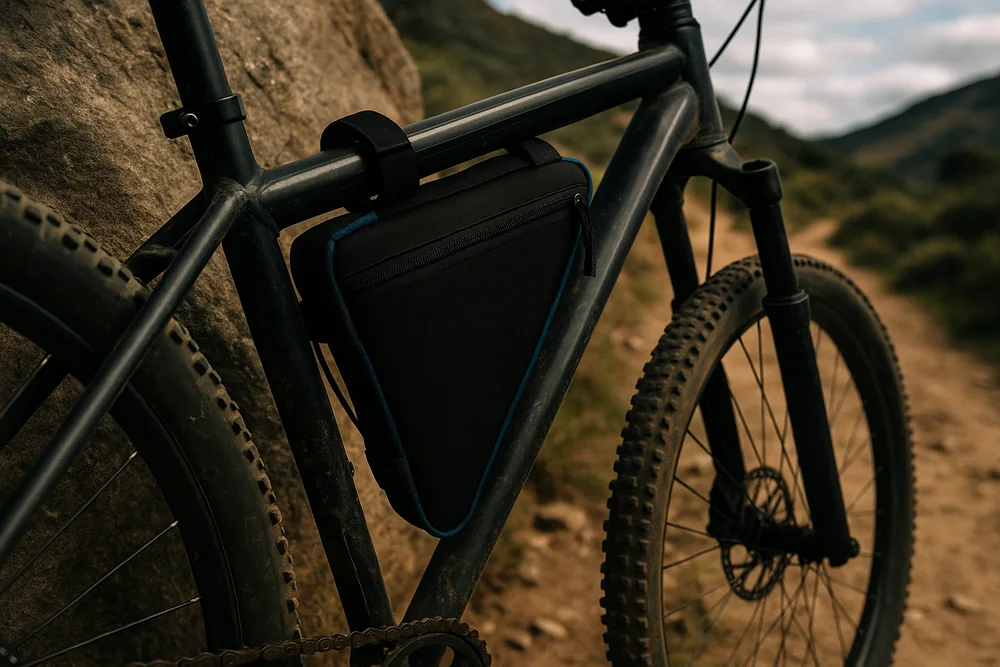
The frame bag's whole case rests on one piece of physics: it puts your heaviest items between the two wheels and close to the ground. That is the most stable place you can carry weight on a bicycle. The bike tracks straight, corners predictably, and doesn't get shoved around by crosswinds or thrown off balance on descents. Load a full multitool, a spare tube and a mini pump into the triangle and the bike barely notices the extra weight is there.
The Ridgeline Trail is a triangle frame bag built from tough, water-resistant Oxford/nylon fabric, secured with three velcro straps — two on the top tube and one on the down tube. Because it straps on, it needs no frame eyelets or mounting bosses, so it fits almost any road, gravel or hardtail mountain bike. Buyers back up the stable fit: one wrote, "Excellent quality! Sits snug in the frame and doesn't rattle on rough ground." That rattle-free fit is exactly what you want when the terrain gets rough.
Pros: best handling of any bag; frees your back completely; no mounting hardware needed; great for dense, heavy items; out of the way when you're riding hard. Cons: access is moderate — you reach down and unzip rather than grabbing from a pocket; very small or full-suspension frames leave less triangle room, so you should measure before you buy; capacity is limited to what fits in your triangle. For a deeper dive on carrying loaded gear this way, see our guide to the bikepacking frame bag setup.
Was $39.99 · Free shipping · 30-day money-back guarantee
The saddle bag: bulky, light, and tail-heavy when full
The saddle bag earns its keep on volume. A small under-seat wedge holds a tube and levers out of the way; a large bikepacking seat pack swallows a sleeping bag or a change of clothes. The key is what you put in it. Bulky, light items are perfect — they take up space without adding much weight, so the bike stays balanced. That's why experienced bikepackers stash their sleep system and soft clothing back here rather than in the frame.
The catch is weight distribution. Everything in a saddle bag sits behind and above the rear axle — the worst place to carry anything heavy. Fill a big seat pack with dense gear and the tail starts to wag on high-speed descents and out-of-the-saddle efforts. It's a real, felt effect, not a theoretical one. There's also a sway problem: large seat packs can bob side to side on rough ground unless they're cinched down hard.
Pros: big capacity options; frees your back; good for bulky light gear; keeps the frame triangle open for a bottle. Cons: tail-heavy and wobbly when loaded with weight; you almost always have to stop to open it; large packs can sway on chatter. The rule I follow: bulky and light goes at the ends of the bike; dense and heavy goes in the frame. Get that split right and a fully loaded bike still handles like a bike.
The handlebar bag: fast access, but weight up high
Nothing beats a handlebar bag for grab-and-go. Whatever you put up front, you can reach it without stopping or even slowing much — snacks, a windbreaker, a camera, your phone. On long days that convenience adds up. Bikepackers use big handlebar rolls for exactly this reason: it's dead space that's easy to fill with bulky, light gear you don't need to open often, plus a top pocket for the stuff you do.
The downside is where all that weight ends up: high and out over the front wheel. That raises your center of gravity at the front and adds rotating mass to the steering, so the bike can feel sluggish to turn and heavy to hold a line on rough ground. A little weight up there is fine; a lot of it changes how the bike steers. Cable and brake-line clearance is another real headache — some bars and setups simply don't leave room for a bag without kinking a line.
Pros: unbeatable access while riding; big volume for bulky light gear; keeps items in your eyeline. Cons: weight up high hurts steering; can foul brake and shifter cables; needs clearance many cockpits don't have. If your main goal is keeping your phone up top for navigation, a top tube bag is a smarter, lower-slung answer — more on that below.
Where the top tube bag fits in
Most riders overlook the top tube bag, and it's genuinely the smartest small-bag pick for a lot of setups. The Ridgeline Pilot sits on the top tube right in your eyeline, so you get handlebar-bag access without dumping weight out over the front wheel. It's a hard-shell, genuinely waterproof case with a touchscreen window that fits phones up to 7 inches — so you can navigate a route without ever pulling your phone out. One buyer reported that "the touchscreen window even reads my fingerprint to unlock the phone," and another confirmed "the phone stays dry" through wet rides.
Run a frame bag and a top tube bag together and you've covered the two things that matter most: heavy essentials low in the triangle, and your phone up top and dry. That's the Ridgeline Complete Kit — the Trail plus the Pilot — for $44.99, a $9.99 saving versus buying the two separately.
Trail + Pilot together · Was $74.98 · Free shipping
When to use each bag
Here's how I'd actually choose, based on what you ride and what you carry:
| Your ride | Start with | Why |
|---|---|---|
| Daily commute | Frame bag | Tube, tools and keys out of your pockets, stable handling |
| Road / gravel training | Frame bag + top tube bag | Essentials low; phone up top for data and nav |
| Overnight bikepacking | Frame bag + saddle bag | Heavy gear centered; sleep system bulky-but-light at the rear |
| Multi-day loaded tour | All three | Split the load: dense in the frame, bulky at the ends |
| MTB trail riding | Frame bag | Low, tight fit that won't sway or catch on rough ground |
Notice the pattern: the frame bag is on every line. That's not brand loyalty — it's physics. It's the one bag that improves handling instead of compromising it, so it belongs in almost every setup. The others are additions you make as you carry more. If you ride a mountain bike, our MTB frame bag guide covers the tight-triangle fit in detail; road riders should read the road bike frame bag page.
"On a loaded bike, where the weight sits matters more than how much you carry. I pressure-test every bag on real gravel before it goes live, and the pattern never changes: get the heavy, dense items into the triangle first, and the bike still handles like an empty one. Saddle and handlebar bags are for the bulky, light stuff you can afford to put at the ends."— Marcus Reed, Gear Editor at Ridgeline
Why this matters for more riders than ever
Bag choice used to be a niche concern for tourers. It isn't anymore — a fast-growing base of American riders is carrying more gear on more kinds of bikes, and getting the weight distribution right matters for all of them.
Americans ride a bike each year — a huge pool of riders eventually needing to carry gear
— Outdoor Industry Association, 2023
US bike sales hit record highs during the 2020 cycling boom
— NPD Group, 2021
E-bikes are among the fastest-growing US cycling categories, outselling electric cars in unit sales
— LEVA, 2023
Heavier e-bikes and more loaded commutes make stable weight placement more important, not less. The bag that keeps weight low and centered — the frame bag — is the safe default for that whole growing group of riders.
The honest verdict
None of these three bags is a mistake — serious riders run all of them, each doing the job it's best at. But they are not equal starting points. The frame bag is the only one that makes your bike handle better by putting weight where it belongs, so it's the piece I'd tell any rider to buy first. The saddle bag and handlebar bag are additions you reach for when the frame triangle fills up.
For most riders that means starting with the Ridgeline Trail at $29.99, adding the Pilot top tube bag when you want phone navigation, or grabbing both as the Complete Kit and saving $9.99. Want to see how they hold up over real miles first? Read verified buyer feedback on our reviews page, or the waterproof frame bag guide if wet-weather protection is your priority.
Free worldwide shipping · 30-day money-back guarantee · Secure Stripe checkout
Reviewed and updated July 2026. See how we test.